

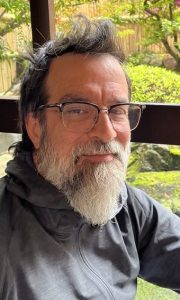
Jack Morgan writes an irregular column on learning to write with brain lesions.
It’s been almost a year since I received my primary progressive multiple sclerosis diagnosis, and anyone who read the first few articles in this column knows that I started my stages of grief deep in a dark place. It felt like a natural starting point for me, but by starting in the depression stage, I skipped denial, anger, and bargaining. Staci, my partner, spent two months ensuring that those earlier stages were well-covered for both of us, but she joined me in despair.
She arrived just as I started to write my way out, though it wasn’t my writing so much as my writing ambition that dragged me through the gravel-strewn grounds of depression to the next stage of grief: acceptance. Then, it took me another six months and one Google search to learn that acceptance is the final stage.
I’m stuck. I live here now. It’s better than despair, no doubt. I don’t hate my disease, and it’s so much a part of my self-image now that I don’t exactly have MS. I am MS. I am male. I am tallish. I am brown-eyed. I am MS.
It’s been an interesting journey. In the very early days I kind of knew I had MS, but I didn’t yet have a diagnosis. I’d seen the phrase ‘multiple sclerae’ in a radiologist’s reading of an MRI, I tried to meet the challenge with a hidden but brute force of optimism, borne, I suppose, by the stormy clouds of inflammation in my cerebrospinal fluid.
“It’s OK,” I said. “Whatever it is, we’ll face it together,” I said. “We’ll be OK.”
That’s what I said to Staci, and it sounds more like acceptance than the brute optimism that shot through me for a few days. I don’t know why I hid my optimism. “This is great! Great! I’ll write about it, make millions, and die a hero.” What could be better than that? A brave, rich, dead hero.
I couldn’t write, though. I couldn’t do anything. I couldn’t remember the day, the task at hand, or even, sometimes, the second half of a sentence I was trying to speak. I was worse than useless. I was a machine that produced for Staci a despair that I could not help her bear.
The Cliff’s Notes cheater’s pamphlet on primary progressive multiple sclerosis (PPMS) is scary as hell. Once a symptom is present, it does not remit. That symptom may not get worse after the onset, though it is likely to worsen (progress) over time. You don’t know if that symptom will pause, slowly progress, or, one night while you’re sleeping, jump forward to its nastiest manifestation. A persistent tingle along the sole of your left foot can turn into paralysis of the whole left side of your body. Mild double vision threatens blindness. Unstable balance, inability to stand. Abdominal pains, shitting yourself for life.
Cliff has some footnotes that we did not appreciate at the time, though we eventually got to them.
Here’s the most important one: Yes, whatever my symptom baselines are, they’re never improving. BUT, some factors can temporarily exacerbate the symptoms, making the baselines look worse than they really are. It is the lesions (small tumors) and demyelination (de-sheathing of nerves) that cause the symptoms and set the symptom baselines, but factors like diet, temperature, stress, and cerebrospinal inflammation (which you may recall from a few paragraphs ago), can make every symptom worse…temporarily.
I lived in Hawaii in a lovely but un-airconditioned condo; I was bleeding cash and sweating stress after losing my career, but I was unable to qualify for disability benefits; I ate like a college freshman; and I had a filthy autoimmune reaction lighting up my cerebrospinal fluid like a glow stick.
Enter Ocrevus, a $40,000-a-dose, twice-a-year knight in shining syringe. It’s the only drug approved to treat PPMS. Two weeks after my official diagnosis and two months after I looked up the word sclerae, Ocrevus knocked out my inflammation in twelve hours. Baseline me, it turned out, was still me. Well, me-ish. I don’t walk well, and after about twenty falls and some encouragement from my son, I now walk with a cane.
I started paying attention to my diet. I dodge heat during the day and sleep on a water-cooled mattress pad (cool, huh?). I try to keep my stress down, though I still haven’t qualified for disability. I take the maximum dose of pregabalin, the highest dose of oxcarbazepine my body will tolerate, and a narcolepsy medication that means sometimes I make it all the way through a day.
I know I’ll never have a regular job again. For every great day I have, I have a day where I need help getting out of bed. Walking across a parking lot can end my day. I don’t have a sense of the passage of time (seriously). My calves are tightening up, and there’s nothing I can do about it. Brain fog. Balance. Spasms in a thigh muscle I’ve never heard of. Abdominal spasms that drop me fast, curl me up, and scare the shit out of anyone around me.
I can live with all of it. Honestly, seriously, I can live with all of it as long as I can write. And I can write, sort of. I write beautiful sentences and lyrically fluent paragraphs where the meter reflects the rising tone, then holds back, just so. However, that thread of tone that passes through my perfect paragraph is one of dozens of threads that a novelist must hold simultaneously while weaving, stretching, muting, strumming, and reflecting.
That part, that complex part, I can’t do. I can’t. I’ve been trying for a year. I mean, my penis still works, so it’s not like I have to kill myself if I can’t write, but I’m down to those two things, and I’d like to keep both of them going for as long as I can.
I tried for a year to figure out how to write around my physical constraints. Organizational tools, writing schedules, more active writing environments, less distracting writing environments, and dictation. None of what I tried worked very well, and worse than that, I hated it. I hated the thought of it.
So, I’m making a philosophical shift. I’m trying to think of my physical limitations as creative constraints to work within—guardrails that I use to keep my threads in order.
For example, I’ve stopped creating characters. Characters have too many threads. I write people now. My character sketches are longer than some of my short stories, and I have my main characters summarize their stories from their points of view and in their own voices. Also, I start with real people, and if it gets confusing, I use their real names. Don’t hate me; Joyce Carol Oates does it, too.
One more go at being a novelist.
I started with a short story I wrote a lifetime ago. It’s familiar to me. The people, the setting and era, the trees. I know the truck, the sound of the clutch slipping, then catching, the curve of the rear window. I know the dirt, how when it dries, the clay in the dirt turns to dust and falls away from the fertile earth that was pine needles two years before. The clay that holds everything together is one dry season and one good windstorm away from blowing back into the river.
Lord, how I love the ring of language.
—
I reworked my story, though it’s still the same young man, the same old man, the same truck, the same river. The same dust. This time, the river stretches further, all the way down to the Gulf. The road stretches further, too. One end passes through town, New Albany, and the other end passes the young man and his father, then runs further, a mile or so past Nisha’s house and into a dirt lot on the east bank where the men fish.
I swear, I’m five thousand miles away, and I smell the river. I taste the dust.
This! This is the writing I need.
I opened one end of the story, so it can flow into the next chapter, and I wrote a draft of the next chapter. My writing friends liked my story more after I stretched out the river and the road and opened up one end of the story.
I wrote more, and when we got together to send their writing to agents and publishers, I sent my first chapter to a first-chapter contest. I sent it because I’d been in a writing class when Stephanie Scott visited and told us all about how important a first-chapter contest had been in publishing What’s Left of Me is Yours. Really, though, I sent it in because I was with my friends and Michele recommended a contest with a peculiar name, Gutsy Great Novelist.
I sent it in two days before the deadline.
Based on the subject, I nearly deleted the email without opening it. I
I won the contest. I am certain the universe does not care if I write, but what if it does? And what if this story matters in some way that I can’t imagine that it might? Or, more likely, what if it matters in exactly the way that I can imagine it might? My friends who also love language. My wife, who suffers with me and for me. My children. The river. The road. The dust.
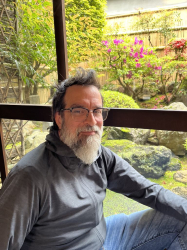
When he's not swimming or paddling in the ocean, Jack works on his current project, We, a novel of love, loss, vengeance, and peace. An excerpted chapter of We has been published in Harvard's The Brattle Street Review. He also writes the twice monthly column "A Work in Progress" for Story Street Writers.
- SSW Interview of Our Summertime Sadness 100-Word Story Contest Winner - September 1, 2025
- A Work in Progress: Year One - April 8, 2025
- What I Learned Judging a Flash Fiction Contest - November 14, 2024
Sign up to our newsletter to receive new articles and events.