
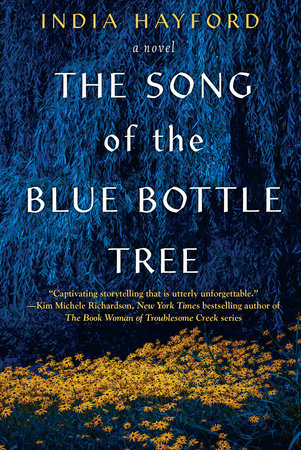
With a name chosen from a gravestone, Genevieve Charbonneau feels ready to visit the only place that has ever felt like home, Arkansas, where her grandmother and mother are buried. Her brief visit takes a turn when she meets a young man just home from Vietnam. Genevieve, who has always talked to ghosts, can see the ones who haunt him, and she gets pulled back into the life of relatives she didn’t know she had. The pain and horrors the family faces leave her fighting her instinct to run, but after escaping from a mental hospital in Alabama and working for a circus, she has lived enough to know that evil doesn’t go away on its own.
The Song of the Blue Bottle Tree by India Hayford is magnificent and grotesque. Some characters and scenes will leave the reader horrified, sickened, and angry. (Read the trigger warnings.) Readers able to persevere are rewarded with a naturalist’s eye for setting and characters (both living and dead) who live on in the reader’s mind long after the book ends.
A stunning Southern Gothic novel by a debut author that reads like a classic in the making, The Song of the Blue Bottle Tree is for readers willing and able to deal with its darkest aspects. A tale of trauma, folk magic, the ties that bind, and the resilience of women, this is a book you will consider throwing at the wall, slamming shut, then rushing to reopen. Magical, heartbreaking, and hopeful, this book is unforgettable.
Thank you to NetGalley and Kensington Publishing for an ARC copy of this book for review consideration. All opinions are my own.
A Writer’s Craft Takeaway
For readers wanting to learn more about writing, India Hayford provides great lessons on first and last lines, both for the work as a whole and for each chapter. I annotate my books, and looking over the highlighted lines, I realized that many were the first or last lines of chapters. Intrigued by this, I decided to look in depth at the author’s choices in each chapter. I found an interesting pattern: nearly every first or last line served at least one of six purposes, with many lines serving more than one of them.
Surprise/Ask a question
When an opening or ending line surprises the reader or encourages them to ask questions, you have provided a hook that keeps them reading. The first line of The Song of the Blue Bottle Tree reads,
“Ghosts started whispering to me by name the spring I turned twelve, the same spring the flesh mounded up under my nipples and the dark moon blood began its monthly flow between my legs.”
If you read the blurb on the back or know anything about blue bottle trees, you won’t be surprised to learn that this novel will involve ghosts. There is, however, something surprising about being dropped as fact in the first line. And in your mind, you immediately have questions. Who is the character? Who are these ghosts, and why are they whispering to her by name? Many of the first and last lines cause the reader to ask questions, which work as breadcrumbs guiding the reader along.
Cliffhanger/Page-turner
A similar but slightly different role is the cliffhanger/page-turner. It forces a reader (as the cliché goes) to the edge of their seat to know what happens next. I often think of cliffhangers as more of a last line of a chapter option, but I was surprised when analyzing the chapters to see how many started on a cliffhanger. First lines that I considered cliffhangers were less of the stereotypical season-ending episode that cuts off as the bullets start flying, and more of the telenovela long-lost lover showing up at the door. But in either location, there was no way I was stopping until I had an answer to “what happens next?”
Answer a Question
Since the first two categories have been forcing readers to ask questions, those questions need to be answered. Often, the answer comes in the body of the chapter, but many questions, cliffhanger or not, were answered by the first or last line of a chapter.
Ground in Scene
Grounding in scene is the only category used primarily for the first lines. I don’t know how a writer could make it to the last line without providing a setting or context for the chapter. The Song of the Blue Bottle Tree is a multiple POV novel, so it is critical that the reader knows where they are when the perspective switches, and especially if there has been a big jump from the previous chapter.
Although the reader must be grounded in the scene throughout the chapter, the occasional last line would serve as an atmospheric description of the setting with a possible hint of foreshadowing. These last lines served more than one function, with the atmospheric description as just a piece of the sentence’s purpose.
Character Insight/Voice
India Hayford, like many authors of multiple POV books, uses the chapter title to alert the reader to the perspective they will inhabit for that section. This cue to readers does not let the writer off the hook for making the characters have different voices. The first line would often be enough in the character’s voice, knowledge, or personality to make the chapter title unnecessary. Many of the first and last lines provided insight into a character’s interiority.
Trigger Emotion
The final category I discovered was to trigger emotion. This was primarily used in the last lines because the writer had to earn the emotional response. If you have heard the advice to “end on a tap rather than a bang,” you’ll recognize the power of the last line that pulls at the readers’ emotions by giving them a soft place to land. But, with that in mind, to show that rules are always meant to be broken, there is a last line in one of the chapters that feels like a sucker punch, knocks all the air from your lungs, and leaves you heartbroken by the unfairness of life.
Conclusion
Reviewing each chapter’s first and last lines was a fascinating craft exploration. My biggest takeaway was not just the six purposes I identified, but how many of the sentences served more than one purpose at a time. One of the chapters opens with just one word, and that one word surprises the reader, provides character insight, and acts as a cliffhanger.
First and last lines get a lot of attention for good reason. You can read Elieen’s article about first lines here and Michele’s about last lines here. Whether we want to accept their importance or not, the first and last lines will receive extra scrutiny. After this thought exercise, I know that when it comes time for final edits, I will spend one edit looking at just the first and last lines of each chapter.

- Harlem Rhapsody by Victoria Christopher Murray - December 4, 2025
- “The Song of the Blue Bottle Tree” by India Hayford - May 15, 2025
- “Soft Burial” by Fang Fang - April 24, 2025
Sign up to our newsletter to receive new articles and events.