

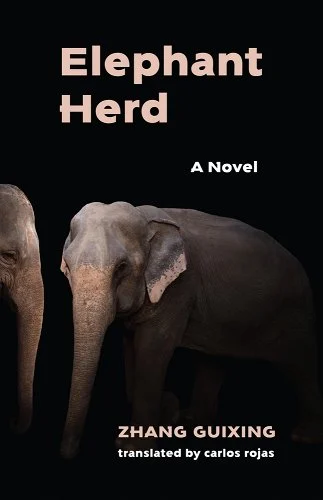
Elephant Herd by Zhang Guixing, translated by Carlos Rojas, follows Shi Shicai as he travels in the rainforest searching for his uncle, the leader of a communist guerilla group. The novel jumps in time mid-paragraph, blurs humanity and nature, and includes elements of magical realism. It is a challenging read that demands a reader’s concentration and a willingness to be lost.
The writing is crowded with images and descriptions of the flora and fauna of the rainforest. As the reader picks their way through the novel, it pulls them without warning to different timelines. The translator, Carlos Rojas, does a wonderful job of helping the reader adjust to the writer’s style early in the novel by including line breaks between the time jumps and slowly weans the reader off the visual aid as the novel continues. The introduction by Rojas is a valuable read for understanding the novel and the difficulties of its translation.
Exploring the effects of the communist uprising, the complicated dynamics between ethnic Chinese, Malays, and the Indigenous Iban community, and the responsibilities of families, Elephant Herd is for readers willing to engage with a novel that boasts of its own weirdness.
I read it. I think I really liked it. I know I need to read it again. Thank you, NetGalley and Columbia University Press, for providing an advanced copy for review consideration; all opinions are my own.
There are many great takeaways for writers wanting to learn more about writing from Elephant Herd, including how to write nature in a beautiful, sometimes scary, and immersive way. The main lesson I want to explore further in my second reading is how the changes in the timeline were handled. How do these jumps in time feel more natural by the novel’s end and become easier to follow? What clues help orient the reader in time?

- Harlem Rhapsody by Victoria Christopher Murray - December 4, 2025
- “The Song of the Blue Bottle Tree” by India Hayford - May 15, 2025
- “Soft Burial” by Fang Fang - April 24, 2025
Sign up to our newsletter to receive new articles and events.