
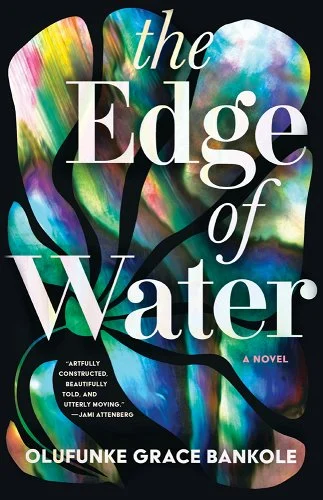
The Edge of Water by Olufunke Grace Bankole is a beautiful and complex novel that explores the love, longing, and complexities of mother-daughter relationships across three generations. Set in Nigeria and America, the story blends Yoruba culture, traditional religion, Christianity, and what it means to belong.
The voice of the priestess Iyanifa and chapter headings in the symbolic shapes of shells guide the reader through this multi-perspective novel. Each character is given their full, messy humanity through the things they share and the secrets they keep. Esther’s letters to her daughter, Amina, in America reveal all the things she couldn’t say when they lived together in Nigeria, including the divination that warned of danger if Amina ever left her homeland. Amina, sheltering in the Superdome with her young daughter, must examine her past while holding out hope for a future that seems less and less certain.
Beautifully written and emotionally riveting, with characters that will stay with you long after you have stopped reading, this book is for anyone who enjoys messy families, multigenerational stories, and the impacts of culture and diaspora. Thank you to NetGalley and Tin House for providing me with an advanced copy for review consideration; all opinions are my own.
The writing lesson I learned from this novel is very personal to my writing experience. The Edge of Water is a work of fiction with a true historical event at its center, and in the Author’s Note, Bankole specifies that she has changed facts to better serve the characters and story. I am currently working on a historical fiction novel and have been struggling to move forward in my writing, seemingly paralyzed by something that I couldn’t name. In reading this novel, the Author’s Note, and this interview, I realized that I have succumbed to the fear of getting it wrong. I’ve been repeatedly warned and told not to get bogged down in the facts and that I’m writing fiction, but the lesson seems to constantly slip my memory. I’m grateful for this novel, which reminds me once again that writing is art. My goal is to strive for philosophical and universal human truth over the facts.

- Harlem Rhapsody by Victoria Christopher Murray - December 4, 2025
- “The Song of the Blue Bottle Tree” by India Hayford - May 15, 2025
- “Soft Burial” by Fang Fang - April 24, 2025
Sign up to our newsletter to receive new articles and events.