
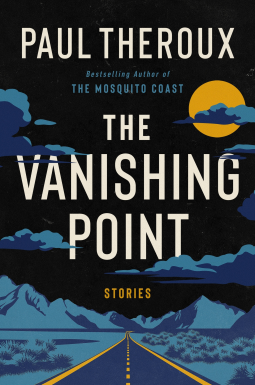
Paul Theroux is a prolific author who, at 83, is reflecting on life and aging in his new short story collection, The Vanishing Point. The stories are mostly unrelated (except for the last section, which focuses on the character Andy Parent). However, they all deal with the moments in a character’s life when all their decisions and circumstances converge to leave what seems to be an endpoint but is more accurately the unknown.
Each story is filled with multifaceted, vivid characters caught in the movement of their lives. One of my favorite stories, Dietrologia, tells the story of an unhappy old man recounting his life story to a group of children before he finally recognizes what has been right in front of him all along. Dietrologia is an Italian principle advocating for skepticism toward surface meanings and encouraging a search for a deeper hidden significance. Every story compels the reader to engage in dietrologia. While it may be argued that all art demands this practice, the stories in this collection particularly thrive on it.
Readers who enjoy short stories will enjoy The Vanishing Point. Paul Theroux is a master of the form, and his new book does not disappoint. Thank you to NetGalley and Mariner Books for providing me with an advanced copy for review consideration; all opinions are my own.
For writers interested in learning more about writing, The Vanishing Point offers a perfect opportunity to dissect what makes a short story successful. Once you have finished reading, I recommend you return to a story that stands out in your memory and study it, asking questions about what makes it powerful and memorable. Interrogate the different elements of the story.
Characters – How do you get a sense of them? What makes them stand out as a real complex individual? The space in a short story is limited. What is the author doing to make you care for the character? What does the character want? Does that motivation drive the story?
Setting – How much of a role does the setting play? Does it inform the mood or possibly contrast it?
Plot – How does the plot build? What is the conflict? Do the main character’s decisions drive the plot? Where does the story climax?
Ending – Is there a soft place for the reader to land? Do you know what happened, or is the ending ambiguous? What emotion are you left with upon finishing the story? Can you pinpoint places (events, word choice, phrases, etc.) that have influenced that emotion in you? Is there a call-back to the beginning of the story?

- Harlem Rhapsody by Victoria Christopher Murray - December 4, 2025
- “The Song of the Blue Bottle Tree” by India Hayford - May 15, 2025
- “Soft Burial” by Fang Fang - April 24, 2025
Sign up to our newsletter to receive new articles and events.