
I’m not a painter or a composer, but I imagine all artists go through a similar creative process: ideation, experimentation, consolidation, and culmination. While all stages have their challenges, it may be the final one that causes the most pain. When does a painting not need one last stroke? A sculpture, one last chisel? A song, one last arrangement? As a writer, when do you stop editing yourself? Every time you read a text, you’ll find a word that could replace another, a missing comma, or a repeated gesture.
One of the reasons I participate in writing contests is that you have a deadline. There’s a date and a time you need to finish and turn your work in, whether you like it or not. There’s no possibility of another go-around, one last check, one last edit. But these are primarily for shorter work, and even then, there’s always room for improvement, especially when you’re sharing your art and your heart with the world.
Yes, I’m a perfectionist. Not to the extreme of it holding me back or prompting me to burn what I write, but I strive to produce quality work, and it’s hard to feel like I’ve reached the mastery required to stop doubting myself— and maybe that’s a good thing.
Reading this, it may not surprise you that I’ve been working on the same manuscript for nearly a decade. Letting it rest in intervals but picking it up again to keep chiseling at the edges. And yet, I couldn’t get the notion of an unfinished task out of my head, like that one lyric you can’t stop singing. So, I came to a point where I needed to stop. But before that, I did one last revision, which turned out to be deadly tedious but pushed my narrative style to its most creative extreme. Before turning a manuscript in, I searched for my most overused words and tried to eliminate or change what I could.
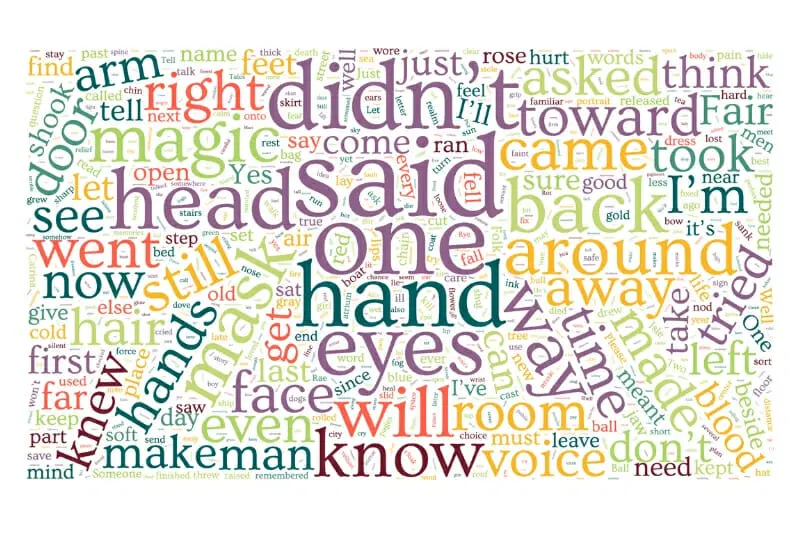
For those of you who use Scrivner like me, you’ll be happy to know that it has a feature that does this for you. You go to Project – Statistics – Word Frequency and brace yourself to find how many times you’ve used the word “just.” Microsoft Word and Google Docs do not have this feature. A quick research came up with a way to put your text into a Google Sheet, but that’s way beyond my level of Excel-type software use. What I did find were some online word frequency counters that can help with this task.
Once I got my results, I went down the list, which at the top was littered with articles, pronouns, conjunctions, and character names. Those I ignored because they have a purpose. Below that, I found that my most overused word that did not fall into any of these categories was “back.” Back as in step back, look back, back of the neck, and many other variants I had not been aware of. So I did a Ctr+find and went through the whole 62,000-word manuscript, checking for all the instances in which I could delete the use of “back” or change it to something else. When I finished with “back,” I noticed that my list was way too long to do this one by one, so I copied those that most troubled me, made another Ctr+find listing ALL these words, and my document lit up like string lights hanging across the pages. And so it began. Chapter by chapter, I had to decide which of these overused words were needed and which were not, marking the places where I fell into my comfort writing zone, using boring gestures, reactions, or descriptions. Then, I had some serious rewrites to do.
I don’t need to stress how grueling this was, but in my case, it was worth it. Not only did I catch myself being lazy and unimaginative at times, but I had to come up with new phrasing, metaphors, and stylistic choices. Then, I reviewed the whole manuscript AGAIN to ensure I hadn’t left unfinished or meaningless sentences. I even put some of those dreaded “backs” back.
You might be exhausted just from reading this, but this exercise forced me to view my writing objectively. I couldn’t ignore so many highlighted words, knowing I could do better. Now, I have to look away, accept that finished is better than perfect, and trust my creative achievements.
She worked as a journalist for Grupo Reforma in her hometown of Monterrey, Mexico and taught high school Spanish and Journalism.
Empowering a new generation of writers is her life purpose, as well as publishing her YA novel Synchronicity, which she originally wrote as a play when she was 17. She also finished a two-POV, two-author dystopian YA and other projects. Her work has been published in Lucky Jefferson magazine.
- Revising overused words - March 21, 2025
- So, what do you do? - December 20, 2024
- Surviving Feedback - July 11, 2024
Sign up to our newsletter to receive new articles and events.